The marketplace growth system that drove a 60% revenue lift
Associated with: Multiple Key Accounts
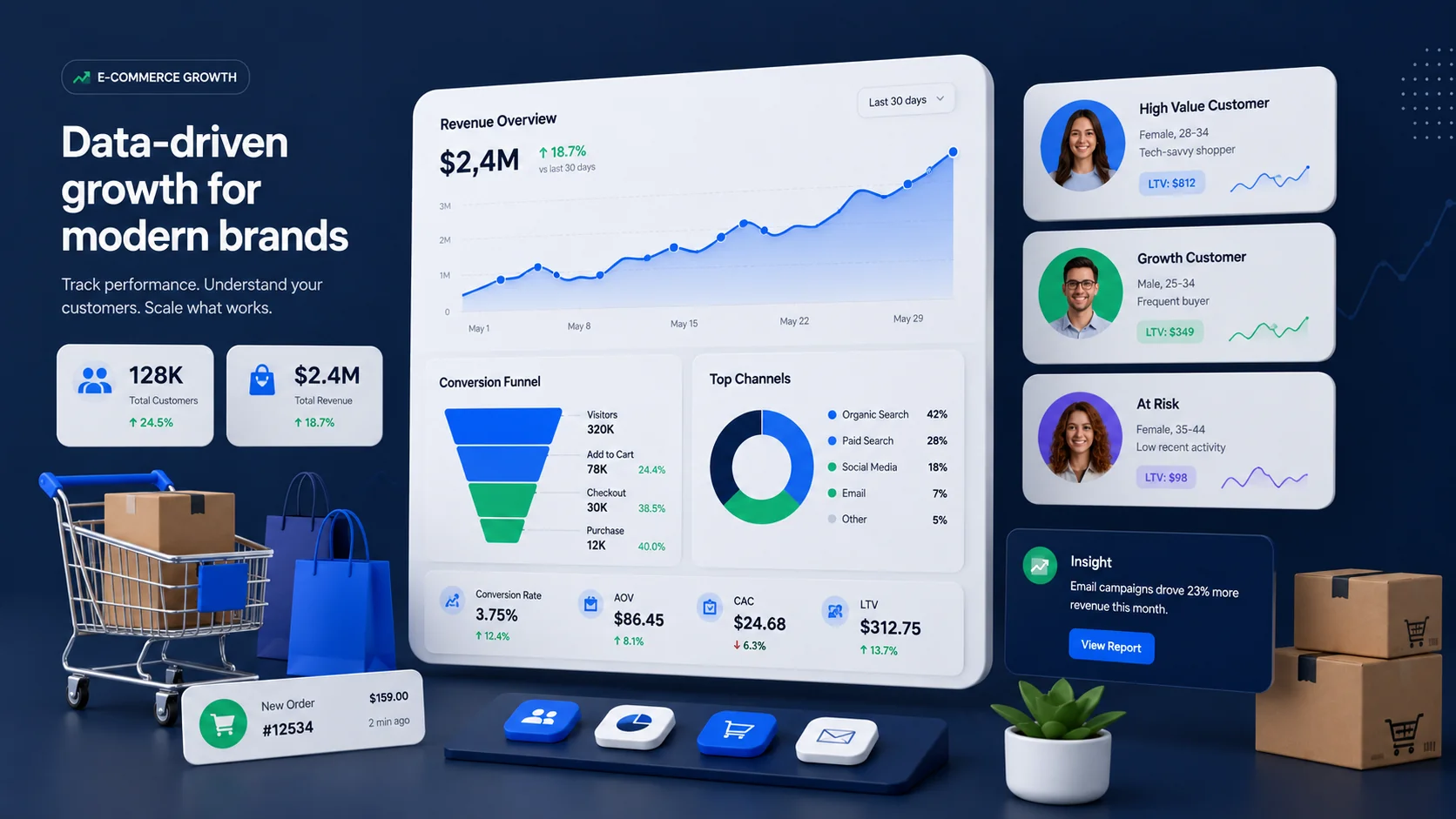
E-commerce brands were leaking revenue because of disjointed, channel-specific optimizations. Here is how I rooted our marketplace levers in deep user research, built a unified growth system, and scaled our client portfolios from a baseline of $30k to $45k MRR in under six months, all while maintaining strict profit margins.
A marketplace growth system aligns user research with paid acquisition, organic visibility, and pricing to predictably scale e-commerce revenue without bleeding margins.
Why isolated optimizations were breaking down
Revenue growth across our key account portfolios was stagnating. This wasn’t due to a single failure, but a chain of disconnected inefficiencies.
Paid campaigns generated traffic, but poor ROAS discipline meant we were paying for the wrong clicks. High-intent marketplace searches bypassed our products because our catalog structures didn’t match how real people searched. Pricing and conversion bottlenecks caused friction mid-funnel. Finally, client decisions were reactive because we didn’t have data showing which changes actually moved the needle.
We needed to stop guessing. We had to transition from ad-hoc tweaks to a systematic, full-funnel marketplace growth strategy driven by actual user behavior.
Owning the execution from research to results
As the Key Account Manager, I owned the end-to-end growth execution. My responsibilities bridged strategic diagnosis and ground-level execution:
- User Research & Diagnosis: Conducted deep qualitative and quantitative user research to understand buyer intent, friction points, and search behavior.
- Performance Marketing: Optimized PPC campaigns by refining targeting and spend allocation based on validated user intent.
- Marketplace SEO: Leveraged user research and search query data to restructure catalog architecture and product discoverability.
- Data & Analytics: Tracked KPIs in Metabase to pinpoint conversion bottlenecks and margin risks.
- Client Strategy: Led structured client sessions for performance demos, commercial alignment, and contract discussions.
User research as the diagnostic foundation
Before deploying more ad spend, I diagnosed the conversion funnel by asking four questions rooted in user behavior:
- Where are we paying for traffic that doesn’t match the user’s actual intent?
- What language are users actually typing into the search bar that our listings are missing?
- Why do users abandon the cart? Is it price, lack of trust, or missing product information?
- What data do clients need to make proactive decisions instead of reacting to last week’s sales dip?
By fusing campaign reports, search behavior, catalog performance, pricing data, and direct user research, I pinpointed exactly where each account was leaking revenue.

How we mapped user insights to growth levers
1. Paid Acquisition: Stop paying for low-intent traffic
Paid traffic can hide marketplace weaknesses. If your listings don’t solve the user’s problem, more spend just accelerates your losses. We restructured PPC execution around profitable, researched intent.
- How it works: We reallocated budget toward keywords and products where user research showed strong, high-intent conversion signals. We tightened audience targeting to reduce wasted clicks and monitored ROAS, CPC, and CTR at a portfolio level. Budget only scaled after campaigns demonstrated repeatable efficiency.
- The outcome: We established scalable traffic quality and stopped budget bleed.
2. Marketplace SEO: Highly Qualitative Flagship Optimization
Marketplace SEO compounds over time. When your listings use the exact phrasing your users do, organic discovery skyrockets, reducing your reliance on paid traffic.
- How it works: Rather than relying on automated keyword scraping across thousands of SKUs, we took a highly qualitative approach. We manually analyzed a narrow set of top-selling flagship products, diving deep into customer reviews to understand exact buyer phrasing and friction points. We mapped these high-intent terms to product titles, descriptions, and backend attributes for our priority catalog.
- The outcome: Organic discoverability for high-value search terms drastically improved on the products that actually drove revenue.
3. Conversion & Pricing: Fix the friction, not just the price
User research showed us that conversion drops weren’t always about being too expensive. Often, it was about poor offer positioning or a lack of trust in the listing.
- How it works: We built Metabase KPI dashboards tracking views, clicks, add-to-cart rates, and margins. When conversion dropped, we looked at the user experience. We adjusted pricing levers when necessary, but we also improved product imagery and descriptions to remove buyer hesitation. We balanced top-line growth with margin discipline.
- The outcome: Conversion rates improved while overall portfolio profitability was protected.
4. Execution: Turn insights into client action
Better ads and SEO only work when stakeholders are aligned on what to fix next.
- How it works: We replaced ad-hoc updates with structured growth reviews. We built performance demos linking our user research and marketplace levers directly to business outcomes.
- The outcome: Decision-making accelerated, creating clear accountability across clients and internal teams.

Adapting the playbook: Algorithmic Exploitation
While the core system is universal, execution was tailored to exploit the specific ranking algorithms of individual marketplaces:
- Flipkart: To exploit Flipkart’s visibility algorithm, we focused heavily on securing the F-Assured badge and optimizing conversion velocity. We manipulated visibility metrics by ensuring massive stock depth prior to major sale events (like Big Billion Days), as the algorithm heavily penalizes out-of-stock history. We also executed hyper-targeted sponsored placements focusing on category-specific intent rather than generic broad terms, effectively “training” the algorithm that our products converted best for specific niches.
- Meesho: Since Meesho operates on a 0% commission structure for sellers, algorithmic visibility is heavily dictated by ad spend velocity and catalog quality tiers. We leaned aggressively into their Product & Price Recommendation algorithms based on trending regional searches. To maintain our seller tier status, we rigorously monitored the Quality Dashboard to keep returns minimal, and championed Next Day Dispatch: our research showed that on Meesho, fast shipping velocity acts as a primary trust signal and a massive algorithmic ranking factor.
The results: Scaling to $45k MRR
The implementation of this research-backed system successfully scaled managed client portfolios from a baseline of $30k to $45k MRR within 3 to 6 months, while maintaining strict ACoS and profit margins.
| Growth Lever | Baseline Problem | The Intervention | Business Impact |
|---|---|---|---|
| PPC | Spend misaligned with user intent | Refined targeting using user research | Improved ROAS discipline |
| Marketplace SEO | Missing high-intent organic searches | Restructured listings using real user phrasing | Enhanced organic visibility |
| Catalog | Priority products hard to find | Improved titles, attributes, and grouping | Stronger shopper confidence |
| Pricing | Decisions lacked data backing | Used Metabase KPIs to adjust price levers | Improved margin control |
| Execution | Reactive client reviews | Led structured, data-backed growth sessions | Cross-functional alignment |
What we learned
Marketplace growth accelerates fastest when paid and organic systems reinforce each other. But none of it works if you don’t understand the user. Paid campaigns yield higher returns when listings match search intent. Marketplace SEO compounds faster when catalogs reflect real search demand. Pricing is most effective when tied to conversion data.
Growth is a system, not a channel. When you root that system in user research, scaling revenue becomes a predictable process rather than a guessing game.